
What is No-Bake Molding?
No-bake is a popular sand casting and molding process. A liquid chemical binder is mixed with sand, and the mixture hardens at room temperature, forming a rigid sand mold. Because it is chemically bonded and then cooled at room temperature, it is known as ‘no-bake’–unlike green sand castings, which are generally made with a mixture of silica sand, clay, and water and don’t use a chemical binder. The no-bake process is also commonly referred to in the industry as airset casting or chemically bonded sand molding. No-bake castings are sturdier than green sand castings, but both types have their uses.
No-Bake Foundry Process
In a no-bake foundry system, sand is conveyed to the mold filling station to be prepped for filling the molds. Once at the filling station, a mixer is used to blend the sand and chemical binder together. No-bake uses liquid chemical resins and catalysts (like phenolic urethane).
The sand and chemical binder mixture is then removed from the mixer and used to fill the mold’s cope and drag. A refractory coating is sometimes applied to the cope and drag before they’re pressed together. The cope and drag are then compacted around a pattern to form a strong, dense sand mold. If needed, a core is inserted between the cope and drag to leave a cavity within the mold.
Then the hollow mold cavity formed by the combined cope and drag is filled with molten metal to create the metal part. The molten metal is left to cool inside the mold, solidifying it into the desired final part.
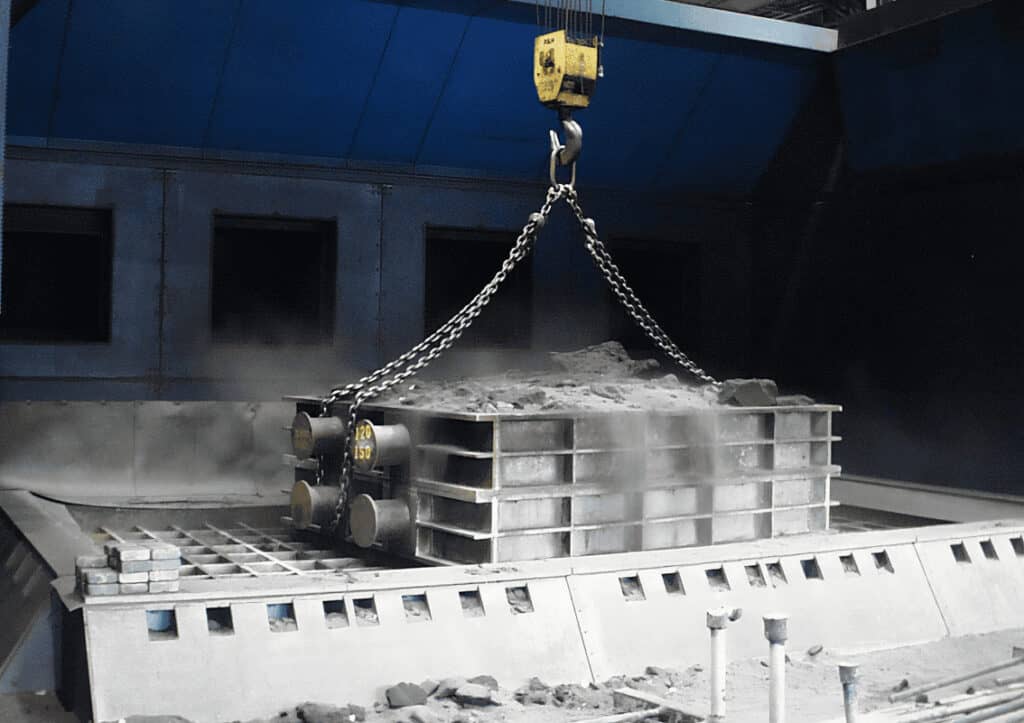
Once the metal is cooled, the mold is sent to the shakeout area to remove the molded sand mixture from the cast pattern. Special equipment, such as the VIBRA-DRUM® or No-Bake Shakeouts, breaks the sand molds off the solidified metal casting without damaging it. Afterward, the sand broken off the molds is reclaimed and recycled for future use.
Once the castings are cleaned and the sand is reclaimed, the casting is sent to the final area for finishing. Thanks to the precise nature of no-bake, not much finishing is typically needed for no-bake castings, but it is sometimes done regardless to touch them up.
Advantages and Disadvantages of No-Bake
Advantages
No-bake has several advantages over other casting and molding processes. Many foundries choose no-bake over green sand for various reasons, including:
- Better Dimensional Accuracy: It offers excellent size tolerances and dimensional consistency thanks to the molds’ rigidity once solidified.
- Detail: Because no-bake offers excellent dimensional consistency, it excels at producing components with many fine, complex details, similar to those produced by investment casting.
- Quality: Any casting that requires a specific level of quality is ideal for no-bake molding.
- Surface Finish: The surface finish of no-bake castings is excellent and often requires little to no finishing, depending on the item.
- Sizing: Green sand casting can’t make large objects, making no-bake perfect for them. It is also more cost-efficient to make large castings using this method. With no-bake, castings up to 50,000 pounds can be created!
- Tooling Costs: Tooling costs are less compared to green sand.
Disadvantages
Despite its many strengths, no-bake casting can’t handle the heat when it comes to:
- Production Volume: Unlike green sand casting, no-bake is unsuitable for high-production-volume jobs. Due to the slow curing time and material costs, mass production isn’t worth the investment.
- Cost-effectiveness: Chemical materials and equipment are expensive, especially when getting started. Unless you know you’ll be making large castings at low or medium volume, green sand casting is the way to go.
Streamline Your No-Bake Process with GK Systems
Are you looking to build a new foundry or upgrade your existing one? From conveying to shakeout, GK Systems has the perfect solution for your no-bake foundry system. Contact us today, and we’ll help you build an efficient, profitable foundry system.