
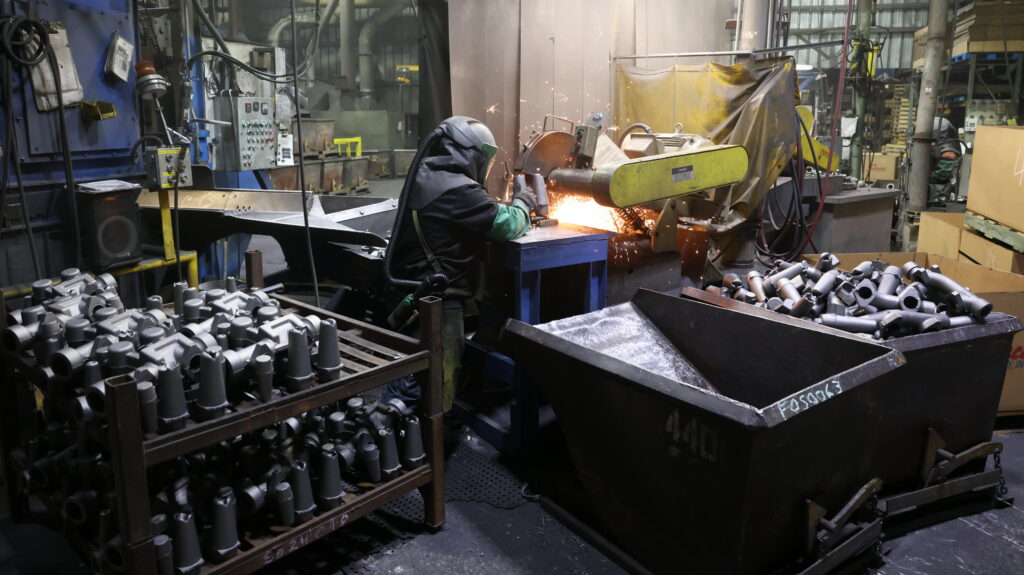
Foundry Hazards
Modern foundries follow safety procedures and use new technology to minimize the risk of employee injuries. Despite this, it’s critical for both foundries and all on-site personnel to understand potential hazards and follow best practices to minimize the risk of injury so everyone can go home safely at the end of the day. With proper equipment, training, and supporting systems that minimize environmental hazards, foundries are safer than ever.
Core Hazards
Molten Metal
Because foundries deal with metal casting, molten metal is the most common hazard foundry workers encounter. Burns from molten metal, usually from furnace explosions, splashes, ladles, and runouts, are all dangerous and more likely if proper PPE use and operational procedures aren’t followed. In melt, pour, and shakeout operations, zone demarcation, equipment guarding, and traffic flow planning are design decisions that are far easier to get right during facility layout or equipment installation than after incidents expose gaps.
Heat Exposure
Just because you’re not exposed to molten metal doesn’t mean you’re protected from heat-related injuries. Hot environments in foundries are dangerous without proper precautions. Heat stress, dehydration, hot surfaces, and extended exposure to heat are all risks. Over time, heat exposure can lead to heat rash, heat stroke, impairment, along with potential fainting, which can lead to more severe injuries.
Dust and Fumes
In foundries, respiratory equipment is often required due to high levels of silica dust, metal fumes, and gases. Airborne hazards are more often long-term risks than acute, but it’s still critical to protect yourself and others from them by wearing proper PPE. Airborne hazards can be mitigated with effective environmental systems, such as fume-collection and dust-containment equipment, or local exhaust ventilation systems.
Some foundry equipment comes with built-in ventilation and duct systems for silica dust management. Others offer add-ons such as dust-containment covers and ventilation systems to further contain silica and other airborne contaminants. Always ask an equipment or system provider about dust-containment options when planning your operation.
Operational Hazards
Cranes, forklifts, ladels, and other equipment need to be operated safely and their operators must follow proper procedures during operation. These hazards are particularly prevalent during shift transitions when traffic density increases. Proper training on machine operation, safety procedures, and emergency response is essential.
Noise Safety
Although less obvious than heat exposure, noise and vibration are often overlooked as safety hazards. Shot blast equipment can hit 100-110 dBA, while grinding can hit as high as 115 dBA. Over an 8-hour shift, the permissible exposure limit (PEL) is 90 dBA*. PPE helps, but moving employees away from harmful noises (via engineering controls) or reducing exposure with shorter (or rotating) shifts is a better way to ensure they remain safe.
*While 90 dBA is the PEL, reaching an 8-hour Time-Weighted Average (TWA) of 85 dBA or higher is the threshold that legally requires employers to implement a formal Hearing Conservation Program, per OSHA.
Safety Precautions: Layering your safety protocols
While things like PPE, training, and safety knowledge help, keeping your foundry as safe as possible often requires a more layered approach. That way, if one technique fails, the next protects personnel from injury.
Engineering and Administrative Controls
Designing your foundry and managing operations so they minimize risk to employees is the first step. Furnaces and ladles, for example, should be designed to minimize the potential for runout. Maintenance should be thorough, and guardrails and other machine guards should be in place where there is any operational risk for employees. All equipment should have emergency stop buttons and lockout/tagout procedures.
Personal Protective Equipment (PPE)
While it must be used in tandem with other safety measures, PPE functions as the last line of defense, critically important, but not a substitute for upstream controls. Everyone in a foundry should wear eye protection, helmets, gloves, and steel-toe shoes. Task-specific PPE selection matters here: aluminized suits and heat-resistant leather footwear for melt-and-pour operations; respirators rated for the specific airborne contaminant profile of each area; face shields for grinding and pouring tasks; and hearing protection matched to measured noise exposure levels.
Building a Safety-First Culture
Building a culture of safety starts from the top down. Training, near-miss reporting systems, and genuine worker involvement in hazard identification create an environment where risks are surfaced before they materialize. Even the most sophisticated engineering controls can’t protect a workforce that’s disengaged from or uninformed of the safety program.
Hazard Identification and Risk Assessment (HIRA) works as a foundation for safety protocols. The HIRA process identifies hazards, identifies who may be exposed and under what conditions, assigns risk levels based on likelihood and severity, and prioritizes the implementation of safety protocols accordingly for every step of your process. HIRA outputs should be updated and reviewed regularly, especially after process changes, incidents, or at defined intervals.
Rounding it all out is emergency preparedness. Fire prevention measures, runout containment procedures, clearly marked and unobstructed escape routes, regular evacuation drills, and accessible first-aid resources are essential in any foundry.
Engineering a Safer Foundry
Safety should never be treated as a checklist. Instead, it should be an ongoing process involving education, controls, employee compliance, regulatory alignment, and direction from management. Foundries that treat safety as a process of its own rather than siloed compliance tasks will consistently see better safety outcomes and more sustainable operations.
If you want to make your foundry safer, contact GK Systems, and we’ll help you engineer a foundry system designed for operational efficiency and safety.